
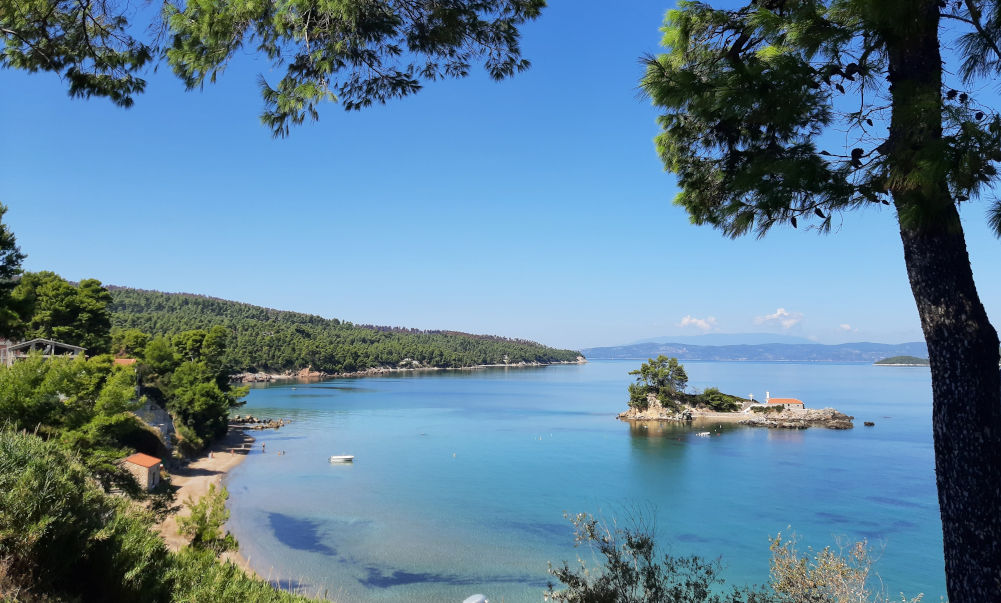
What’s left of the evergreen Eden of North Evia after the wildfires of 2021? An island of simple and pure pleasures that is our second home, we share what attractions remain to be enjoyed.
Last updated 6 June 2026
The 2021 inferno that engulfed North Evia was the biggest Greece has ever seen. Once a lush mountainscape of pine, oak, fir, and olive trees, 51,000 hectares of primary forest went up in flames in eight days. Along with the livelihoods of resin collectors, bee keepers, olive oil producers, and other agribusinesses.
Ours was a farm of almond trees. So heavy with fruit their branches almost grazed the ground. After seven years of waiting for them to mature, they were ready to supply their first yield. But rather than the bountiful harvest anticipated, we walked through scorched rows of skeletons scavenging for nut hulls that looked salvageable.
We had planned to take the girls on their first forest walk through Drymonas and its waterfalls at the start of the summer. Within a week, everything had changed. The forest we longed to introduce them to was gone, leaving little of its quiet magic for this generation to inherit.

WHY NORTH EVIA?
Various reasons may continue to bring you to North Evia: It’s a gateway to the Sporades (Skiathos, Skopelos and Alonissos) from Mantoudi’s new port. You might also be on a healing pilgrimage to Prokopi, also unharmed after a freak rain shower uncannily occurred after believers gathered at its church to intercede for a miracle. Seaside Limni— North Evia’s prettiest village – charms with its elegant waterfront, while Agia Anna’s sweeping sea views remain as captivating as ever despite the loss of its surrounding forest. And then there’s Edipsos, whose famous thermal springs and historic spa hotels emerged unscathed.
FIRST STOP: CHALKIDA
Entrypoint to Evia on the island’s closest point to the mainland, Chalkida is picturesque and petite. Sizable enough to support basic city conveniences for its 100,000 strong population, locals might be able to get their fill of Zara and Oysho, but have to head out to Athens for the cinema.
The city’s feature is a waterside promenade lined with cafes-bars and restaurants designed for family strolls and kiddie scoots. Continue past the old bridge crossing over the “crazy tidal waters” that riddled Aristotle himself, and you will find Asteria. An expansive outdoor waterfront bar and restaurant that welcomes little ones with a playground positioned within clear view of a section of dining tables. If we needed accommodation in Chalkida, we’d look between this part of the promenade and the center, or one of the seafront Airbnbs in Alykes.


Alykes is Chalkida’s summer highlight for us – a child-friendly beach only the locals seem privy to. With clear blue waters that lap over soft golden sand, it’s impressive for these parts. Personally, I find much of the island’s coastline more rugged than remarkable, with darker sands and pebbly shores. Settled by an assembly of cafe-bars for every taste, Daluz at the far right corner (as you face the sea) is our favourite with wood-framed sunbeds, breezy electro tunes, and a gently sloping seabed clear of large rocks.

THE ROAD TO MANTOUDI – GATEWAY TO THE SPORADES (SKIATHOS, SKOPELOS, ALONISSOS)
After leaving Chalkida, the road winds north through pine-cloaked highlands, twisting through 40 minutes of hairpin bends before descending to meet the Kireas River. It used to be prettier here, with thirsty plane trees crowding its banks, filtering the light through a lacework leaf canopy. Today, that beauty has been altered. An invasive disease that specifically targets plane trees has swept through the valley, leaving skeletal trunks where denser greenery once stood.

Not long after, the road reaches Prokopi, the first village of note in northern Evia. It is best known as a place of pilgrimage, where worshippers come seeking the intercession of Saint John the Russian, one of the Eastern Orthodox Church’s most revered saints. Around the church, the village square is lined with shops selling Evian pine honey and other traditional local products, reflecting the steady stream of pilgrims and visitors who pass through each year.


Mandoudi’s village centre is just another 10-minute drive away. Once a thriving regional hub, its magnesite mines and processing plants powered the local economy for decades. Today, like many villages across rural Greece, it has grown quieter as its population has dwindled.
Kimasi beach and port, just a five-minute drive from the village centre, is the gateway to the Sporades each summer. Fast ferries whisk travellers across to Skiathos in 40 – 60 minutes, while the pristine waters of the Alonnisos Marine Park are also within easy reach, making even exotic island escapes feel remarkably accessible for North Evians.
AGIA ANNA – A FAMILY-FRIENDLY COASTAL RETREAT
Our preferred swimming beach in North Evia is where yiayia (Grandma) is from. An endless sweep of charcoal shores, Agia Anna is Evia’s longest beach, looking out into the gentle outline of Skopelos in the horizon. Pebbly on the “organised” end (i.e. with sunbeds and food service), where cafés and tavernas line the boardwalk, the beach gradually gives way to a sandier, wilder stretch that’s home to the simple-but-sleek four-star Thalatta. Bringing a surprise bit of flash when it first arrived on the sleepy village scene, it’s now a seaside destination in itself, fitted out with family-sized rooms (just be careful of stairs with toddlers), airy restaurants, and even a kids club.

Agia Anna has given us some of our most relaxed family days. We linger over coffee and homemade sweets beneath the mulberry trees at Remetzo while the girls transform a weathered tree stump on the beach in front into a vaulting table. Evenings once belonged to Maistrali (closed for the 2026 season), where its enviable beachfront setting became the backdrop for endless games of hide-and-seek during3-hour dinners. For beautifully fresh seafood, Trata is another dependable favourite.
Some menu tips in these parts: order thrapsalo instead of fried calamari – distinctly more tender and tasty. And trade lobster for crayfish – sublimely sweet and delicately succulent. The region is also famed for its specialty shellfish like gialisteres, chténia scallops, and razor clams.

COASTAL DRIVES, SEASIDE TOWNS & THERMAL SPRINGS
A scenic seaside road runs from Limni to Rovies and Edipsos in the northeast. And while the fires consumed Limni and Rovies, it self-extinguished in Ilia before reaching the thermal spring spa town and port of Edipsos.
Built on the prosperity of generations of seafaring captains, the seaside village of Limni is, in our view, North Evia’s prettiest. As tourism has gently gathered pace, once-neglected neoclassical mansions have been restored into boutique hotels, stylish cafés and cocktail bars, while traditional tavernas continue to anchor village life. The Lakehouse and Limni Boutique Experience are the area’s most polished new boutique stays, while Karnagio and Thealos are our top taverna picks—book ahead as tables are often in demand.
True to its name—Limni means “lake” in Greek—the harbour is often so still that it lends the waterfront an almost meditative calm. Its glass-clear waters reveal the rocky seabed below, where children delight in tossing crumbs to darting fish, ducks glide past leaving fleeting ripples, and colourful kaikia—traditional wooden fishing boats—bob gently on the mirror-like surface.

While you might find teens dive bombing off Limni’s pier, we prefer Kochyli’s supersized family umbrellas for swims when Agia Anna gets wavy. Calm and washed over by crystalline waters, its waters are good for tots with some care, as its pebbly seabed gets steep quickly.

If you’d rather combine a swim with lunch or dinner, head one beach further to Paralia. Equipped with sunbeds, umbrellas, a beach bar and a seaside taverna, it’s an easy place to spend the day without moving the car. There’s also a small playground beside the taverna—well used and a little weathered, but still enough to keep younger children happily occupied between bites.

A 30-minute drive from Rovies is North Evia’s most famous draw. The thermal springs of Edipsos drew all from Aristotle and Marcus Aurelius to Winston Churchill by the curative powers of its rich mineral content. A stately 19th century Thermae Sylla Wellness Hotel dominates the small spa town. Natural wells fill its pools daily with enriching waters saturated with metals and chemicals. While its indoor pool is only for guests over 15, infants and young children can enjoy it’s outdoor pool with sea water mixed into its spring waters. If you’re not a hotel guest, you can still enjoy the area’s therapeutic waters in the beach fronting the hotel where spring waters spill into the sea.
FROM EDIPSOS, TO OMPHALOS
Also a small port, from Edipsos you can cross over by ferry (which also transports cars) to the mainland port of Arkitsa in 45 minutes. Why? Because in another hour-and-a-half by car you can find your way to omphalos – the center of the ancient world. Kings, warriors and other supplicants similarly journeyed here seeking guidance from the oracle of Delphi at the Temple of Apollo. Carved into the towering rocks of Mount Parnassus (also a winter ski destination), the temple ruins continue to elicit wonderment. Best visited with a guide, walk its expansive grounds in the cooler months of spring and autumn.
GETTING THERE
Connected to the mainland by bridge, Evia is easy to get to. Chalkida (its capital) is a good day trip destination from Athens in under an hour’s drive. It’s also served by small ferry ports in Mantoudi, Edipsos, Agiokampos in the north, Kymi in central Evia, and Marmari and Nea Stira down south. There is no airport on the island.
