
Which Greek island is the best for families? Where Zeus spent his childhood, of course.
🏖️ 🤿 🚤 🏐🏺 🎨 👨🌾 🐝🏇 ⛰️🏛️ִ
Last updated 23 Jul 2026
Greece is blessed with an abundance of alluring islands. But somehow, on Naxos, its attractions and conveniences all fall into place to take the heat off parents. Like glittering beaches that line-up mile after mile for effortless beach hopping. And how these sublime shores start from the main town, itself conveniently close to both the airport and ferry port. Need a break from the sun? Retire from the beach to swim in a sea of taverna potato chips – homegrown and said to be the best in the country. If anyone is still bored (or burdened), a plethora of children’s activities (pottery workshops, “Farmer for a Day” experiences,, bee farm visits, horse-riding, even a waterpark, and other highly-honed offerings for young tourists) stand ready to relieve parents of fidgety kids in tow.

Naxos may not boast of dramatic landscapes that make for spellbinding memories like Santorini or Milos. But it’s a dream destination for an easy-as-it-gets family holiday, presenting the best of Greece on a convenient platter for frazzled parents among us. And if you would like to avoid renting a car to get around, a decent bus system zips you from town to its main beach attractions.
WHERE TO STAY WITH KIDS
Since our unit of two became four, we tend to seek out accommodation in serene seaside retreats. So we try to avoid the Chora (main town). As well as the seaside villages of Agios Prokopis and Agia Anna (unless you’re staying on its quieter southern end) with one-too-many boutique resorts and beach bars crammed in. In particular, I’d avoid Agios Prokopis with salt lakes behind the beach (visible as three pools on Google Maps) that occasionally omit unpleasant smells.

Moving south through Naxos’ fertile western lowlands, farmland gradually gives way to holiday homes set within generous gardens and open fields separated by tall bamboo hedges. Some are dotted with grazing cows, flocks of goats, and sheep huddled against drystone walls to hide from the midday sun —a veritable animal farm safari for the girls. Strict limits on what can be built on agricultural plots, or agrotemachia, have spared the area from dense coastal development, leaving tourist accommodation pleasantly dispersed across the landscape.

In Plaka & Mikri Vigla, we found a good base for tranquility that’s still close to the best beaches and an attractive selection of restaurants and cafes. Mikri Vigla has the advantage of our favourite beach for family swims, while Plaka is 10 minutes closer to the Chora. Quieter than Plaka, Mikri Vigla is still complete with small supermarkets (we found Campos to be the most well-stocked in the area), bakeries (Naxos Bakery has an enticing selection of breads, cakes, ice-cream, and great coffee), a grill for pita gyros and pizzas, and traditional tavernas.

Our villa in Plaka is exemplary of Airbnb perfection. Seaside Naxos is a small complex of three and four-bedroom units. Spacious and tastefully put together with a coastal cool aesthetic, they’ve thought of all the little details for families – a daily cleaning service, toddler step stools, stair gates, cooking essentials, a blender for baby purees, beach toys and towels, and more conveniences you didn’t know you needed. Its exterior grounds are just as well-furnished as its interiors. With a mini orchard of a garden, the kids launch into a harvesting frenzy picking pears, lime and olives as soon as the sun relents. It felt like home, but better. Our only complaint? Rather than sitting right on the sand, it’s 300 meters away from Plaka beach.

The Chora is often the obvious choice for visitors wanting the convenience of a lively town . Naxos has a lovely one, generously spread out along a sprawling promenade, whitewashed cubic volumes rise gently towards the Venetian fortress on a soft peak encircled by its old town. From here, it’s just a 12-minute walk south to the beginning of the island’s magnificent sweep of sandy beaches. For us, however, there are two reasons to stay elsewhere. Parking is a constant stress point if you’re hiring a car, and with Naxos’s growing popularity, the Chora can feel overwhelmed during the height of summer, with crowds that take some of the shine off its charm.
THE BEST CHILD-FRIENDLY BEACHES
Naxos’ beaches are breathtaking. And you don’t have to drive hours or hike kilometers to uncover pristine beauty. The best bit is a long, southwestern stretch that features an endless length of stunning shores. Mostly “organized” (with shaded sun loungers, as they say in Greece), all the comforts of beach cafes are within easy reach. Make a splash, spread out on your sunbed, and retire to a café behind for food and a frappé. Parking is available behind the cafes that back the beach, so if lugging beach toys in the blazing sun is not your thing, you’ve arrived.

— MARAGAS – pLAKA—
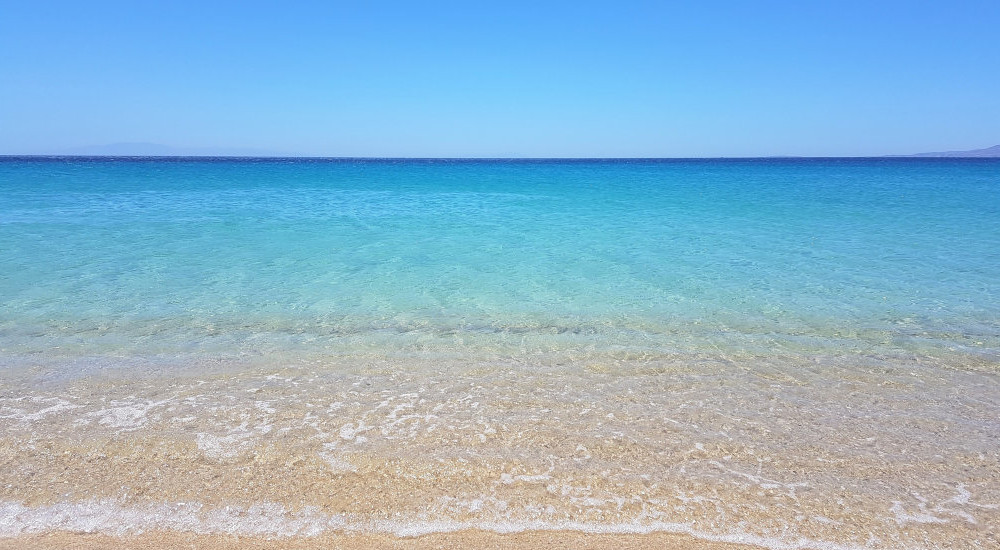
Agios Prokopis, Agia Anna, Plaka and Mikri Vigla all radiate with aquamarine waters and champagne-coloured shores. Gently shelving and calm, the conditions are perfect for child’s play. Agios Prokopis is particularly stunning with shallower waters, but gets chaotically busy in summer for our liking. If you’re going to enjoy the waters here, we would head to the northern end by Molos cafe and taverna. It’s only a short walk from the nearby parking area, and the crowds thin noticeably, making for a far more relaxing section of the beach.


Our preferred part lies south from Maragas – Plaka to Mikri Vigla where the beach gets quieter. Plaka’s other draw is a chic selection of restaurant-cafes spread over swathes of space. Peppermint has the kind of setup that can carry you through an entire day: sunbeds on the beach, a swimming pool for a break from salt water, and a spacious dining area where multiple strollers can be wheeled in endless laps until babies drift off to sleep. A few doors down, Yazoo stands out with creative Cretan-Naxian cuisine, minus any of the pretensions of modern dining.
— MIKRI VIGLA —
From Plaka, the asphalt road to Mikri Vigla soon gives way to dirt. As you approach its gusty north beach bay, a rainbow flurry of kite and windsurfing sails colour the horizon. The “Meltimi” north Aegean summer winds blowing through are an adventurer’s playground. “Ride with the Gods” beckon one of the handful of sea sport centers. Savvy operators have even extended the offering to yoga and Brazilian Jujitsu i.e. activities awash for teenagers.


Continue past the rocky headland to get to Mikri Vigla’s southern bay – our favourite, and top pick for the most child-friendly on the island. Quieter than neighbouring Plaka, only a small section of the shoreline is “organised” with sunbeds and parasols, leaving the rest blissfully undeveloped. Where still and shallow waters stretch out for more than 50 meters, its seabed is free from rocky hindrances. Food and refreshment can be found at Liofagos – the sole no-fuss taverna on the edge of beach, thankfully, it’s a good one. And its final winning feature? The boulder-strewn mini peninsula by the tavern is a natural playground for young explorers and first-time rock-climbers.
Do your kids enjoy a treasure hunt? Look for the Eye of Naxos as you comb the island’s sandy shores. These smooth, polished opercula of sea snails are symbols of good luck and often set into jewellery. We finally found our first, and then two more, at the small swimming bay of Mikri Vigla.
INLAND ADVENTURES
A break from the beach took us on a journey back to 530 B.C. at the Temple of Demeter. Dedicated to the goddess of grain, she blessed the island with fertility and rainfall enough to grow and rear all it needs to feed itself – unique advantages in the otherwise dry and barren Cyclades. Partially restored, svelte pillars and fragmented walls of white Naxian marble stand against a cloudless cobalt blue sky. Combined with imagination and deference to its history, it’s a sight to behold. Easy to reach, the sanctuary is a short and gentle uphill walk from the road where you will park. Few are the trees offering shade, so bring hats and hydration for little ones.

There are around twenty villages to explore in Naxos. From the Temple of Demeter, continue into the mountains towards Chalki, Filoti and Apeiranthos.
— chalki—
Tiny Chalki, once the capital and commercial heart of Naxos, is a delightful place to browse for locally crafted treasures. Its compact knot of picturesque lanes, lined with elegant neoclassical villas, hides an eclectic collection of galleries and artisan workshops. Cafe Greco is a convenient parking spot for kids with homemade sweets, while parents steal into Fish and Olive next door – a jewel of an art gallery with exquisite ceramics. Sculpted by internationally accomplished Katharina Bolesch, ethereal fish and olive motifs in the light, airy style of her partner Alexander Reichardt adorn these elegant keepsakes. Maria Maraki’s loom weaving workshop is a few doors down. Using techniques and patterns passed down from her great grandmother, she is one of the islands few remaining artisans who continue to handcraft heritage textile souvenirs of the ancient art.

Just beyond Chalki, stop by Libertas Manolis’ pottery shop for handcrafted ceramics by a fourth-generation family of potters originally from Sifnos, Greece’s famed pottery island. Our girls delighted in water-filled whistling birds—a Montessori-friendly keepsake that pipes out a surprisingly lifelike birdsong—while ceramic pomegranates, a Greek symbol of good fortune and prosperity, make elegant artisan souvenirs to take home.


Manolis also offers pottery workshops (send a whatsapp message to +30 698 599 5451 to arrange) for children and adults. For younger participants (around nine or ten years old), an introductory experience lasting 30 minutes should suffice. As he candidly explains, it’s more about letting children discover the basics of the craft, with much of the shaping still guided by himself.
— f i l o t i —
Spread across the verdant slopes beneath Mount Zeus, Filoti—once the island’s commercial heart—is the largest village on Naxos. Life centres around the leafy square of Gefyra, where cafés spill out beneath towering plane trees. Once tranquil, the main road skirting the square has now become a busy bottleneck of traffic in the height of summer.

— A P E I R A N T H O S —
Beyond Filoti lies Apeiranthos, a striking mountain village hewn from the marble that surrounds it. Perched 600 metres above sea level on the slopes of Mount Fanari, its stone-paved lanes weave between centuries-old houses, where cafés and tavernas pepper every corner. Many open onto terraces with sweeping views across Naxos’s rugged interior—the perfect setting to linger over coffee, crêpes or a leisurely lunch.


Our recent visit made it clear just how much tourism has grown in Naxos over the past two years. Once a sleepy village, Apeiranthos now bustles with visitors. By 2:30 p.m., almost every taverna along its marble streets was full, with a queue of hungry diners waiting for a table.
In search of respite, we ducked down a flight of stone steps to the hidden courtyard of O Lefteris. Tucked away from the crowds beneath the lacework of light cast by a spreading walnut tree, this traditional taverna offered a welcome pocket of calm. The food delivered, but the painfully slow service tested the patience of many a table around us—perhaps an inevitable side effect of the village’s newfound popularity.
EXPLORING THE MAIN TOWN (& OLD TOWN)
Evening ambles through Greek villages are one of the joys summer days. Naxos’ Chora is a long, large and vibrant one. The famed Portara stands sentinel at one end – a gateway to a superfluity of shops, a dizzying array of wining and dining options, the island’s archaeological museum, car and boat rental operators, and all the amenities to support the island’s 19,000 strong population.

Huddled around a Venetian castle on a hill that forms a natural citadel, wander the quiet alleyways of Old Town that lead uphill for a mesmerizing sunset view. And perhaps a pre-dinner tipple on the rooftop of Avanton 1739. Spurred on by a Frozen- inspired excitement for castles, our 4-year-old (surprisingly) gave us little grief during the climb. The reward? Homemade ice-cream from Aktion on the main waterfront, or profiteroles from Chou Chouro If you have younger ones in your company, consider leaving the stroller behind if you’re going to navigate the backstreets of the main town.


Metaxi Mas is an intimate wood and stone framed bolthole tucked into a table-lined whitewashed walkway. Warm and welcoming, the littlest kitchen inside turns out the pure flavours of Greek classics at their best. Even the moussaka seems special.
At the same time, dining in the thick of town can feel confined for young wanderers. If you prefer settings nestled in nature, where the kids can scamper within sight while you nurse an ouzo, we’ve rounded up some special finds here.
WHEN TO VISIT
As with most Greek islands, the main tourist season runs from June to September. July and August are peak months (and hottest months) I try to avoid as far as possible.
Shoulder season weather (Spring and Autumn) is always lovely in Greece, keeping in mind that most businesses start to open in April, and close in October. The sliver of weeks in between seasons (early to mid June and early to mid September) is probably the best time to go if you want to enjoy swimming without the searing heat, and with a slice of buzz.
By winter, tourism dwindles and most related businesses close down. But the island, with an established agricultural industry and sizeable (for the Cyclades) resident population, retains some life. There are also mountain villages to explore when blustery seaside towns feel desolate and depressed. While Mediterranean winters are mild, visits at this time are at the risk of cold and wet days.
GETTING THERE
Naxos is straightforward to get to: Catch a quick 40-minute flight from Athens airport, or hop on a 4-hour high-speed ferry from Piraeus port in Athens. If you’re flying in from Europe, you can also use the international airports at Mykonos or Santorini as a point of arrival instead of Athens.
Island-pairing opportunities according to ferry links available can be viewed here. Parked between sought-after Santorini and Mykonos, you can alternatively retreat into peaceful seclusion in Koufonisia, a striking little island paradise a 40-minute boat ride away. This is where you will discover some of the truly best beaches in Greece.
FIND FERRIES TO NAXOS
Put in your planned dates of travel for a view of ferries available:

- Getting There:
- Flight from Athens: 40 minutes
- Ferry from Piraeus, Athens: 4 hours via fast ferry option
- Car Rental: Auto Rent-a-Car which has an airport location.
- Eat:
- Avli Taverna (Agia Anna beach)
- Paradiso Taverna (Agia Anna beach)
- Metaxi Mas (Naxos Town)
- Kastraki Paradise (Kastraki)
- Yazoo Summer Bliss (Plaka)
- Drink:
- Cedar Cafe (Plaka beach)
- 520 Bar & Restaurant (Naxos town)
- Supermarket for baby supplies: AB Supermarket (refer to map below). Pharmacies and mini-marts scattered all around should also stock essentials (e.g. wipes and pampers).
- Official Site for local events, festivals and more: https://www.naxos.gr
