
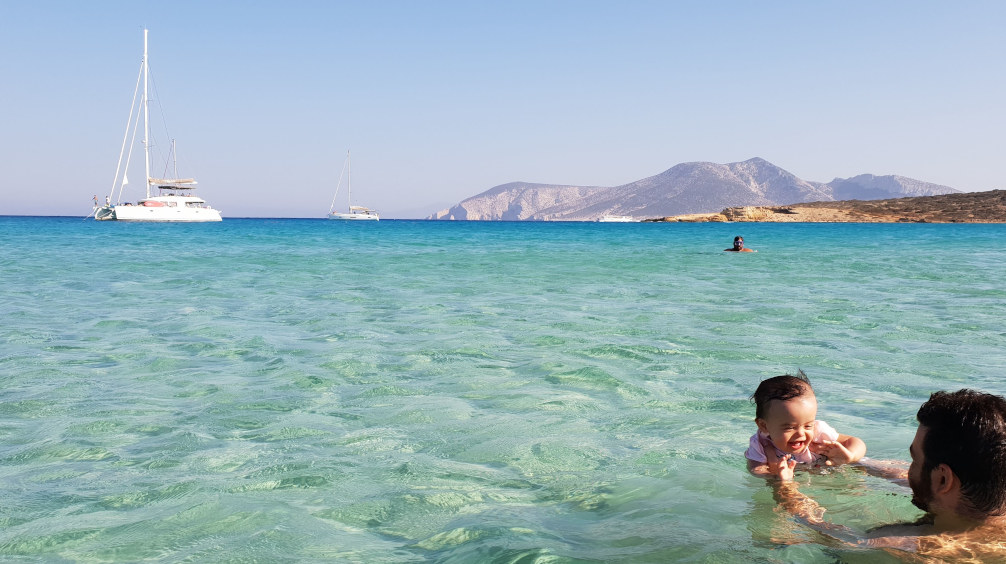
Trip planning is an artform. Weave in airplane crying fits, weaning feeding frenzies, mid-swim poo changes, and the stroller-mangling sidewalks (if any) of Greece, and it takes extra guts and grit. So how do you go from surviving, to enjoying the holidays with kids? At the risk of overgeneralising, we’ve whittled down eight years of hard-fought wisdom into nine quick tips to get you started:
1. Avoid summer
Despite being the most popular months, July and August are, in our view, the worst time to visit Greece. Afternoon temperatures soar, making outdoor sightseeing uncomfortable between around 11am and 5pm. In recent years, climate change has also brought more frequent heatwaves, with temperatures climbing above 40°C, along with an increased risk of wildfires. These conditions can be particularly challenging in a country whose infrastructure is not always designed for such extremes—from limited shade at some of its busiest ferry ports to air conditioning that isn’t always guaranteed. If beach time is high on your itinerary, you’ll likely have a more enjoyable experience by travelling in the last two weeks of June or the first two weeks of September, when the sea remains beautifully warm but the heat is considerably more forgiving.
2. Get a beach house
For families with children under two, it’s hard to beat a villa just metres from the sea. Better still is one that also lies within walking distance of a village – places like Platis Gialos in Sifnos, Livadi in Serifos, Panormos in Skopelos, Mylopotas in Ios, Myrina in Limnos. When your little one drifts off for a nap, you can steal a swim, browse the village shops, or linger over a Greek coffee, all without straying far from home. You may sacrifice a little of the beach’s postcard perfection, but the convenience of having everything on your doorstep is hard to beat.

For families with young children, true beachfront is the summer equivalent of ski-in, ski-out. It sounds like a luxury until you’ve carried a toddler and lugged beach toys down a 200-metre dirt track in 35°C heat. Suddenly, those last few metres become everything.
3. When selecting an island, small (and less busy) is beautiful
Unless your kids love lengthy car rides, anywhere you can drive from one end of the island to the other in 30 to 40 minutes is ideal (e.g. Milos, Paros, Skopelos, Skiathos, but not Mykonos for other reasons). Too large (e.g. Crete, Kefalonia, Evia), and you might have to suffer hour-long road trips to get to key attractions (and back). Small is simple, and simple, oftentimes less stressful. Just remember that small islands are limited with fewer accommodation options, so it’s critical to book early (more than six months ahead, ideally) to secure star finds.
4. Research your beaches
Even lazy beach days require pro-planning prowess. A little foresight and some research goes a long way: Are the waters calm and shallow? Where should you go on windy days (check wind strength and direction here)? Is it organised (i.e. with sunbeds and umbrellas) or without shade? Where will you go for food and drink? Is parking right behind or do you have to descend 300 steps to get there? And then, there’s what to bring. If you like to pack light, make sure you select an island with enough organised beach options for you (e.g. Skiathos)

5. Apartment rental vs hotel?
While I’m generally weary of Airbnbs because of the lack of consistency in how they are run, in Greece, many are managed professionally. Appreciating all the space we can get, and extra free time while the kids are preoccupied with bug hunts in the garden, it’s usually our preferred type of accommodation. Better equipped, breakfasts, snacks and the occasional home-cooked meal are easier to prepare in a full kitchen. And of course, there’s the benefit of having additional bedrooms so we don’t have to tiptoe around the kids in the dark after bedtime.
For short-term stays of 3 days or less, I am inclined to say hotels are the least stressful way to go. Especially after a disaster 2-night trip in a highly-rated Athens Airbnb, when we found ourselves waiting until 10pm on Christmas Eve for hosts to provide complete bedding (the duvets were missing duvet covers in winter) and clean towels (the ones provided were soiled). Hotels are more predictable in terms of what you’re going to get. You also don’t have to worry about loathsome details like taking out the trash (often especially messy business in Greece where you can’t flush toilet paper down the bowl), and cleaning up the constant trail of crumbs on the floor.
Which leads us to the real ideal – apartments with the full service of the hotel. Combining the benefits of an apartment with daily cleaning services, this is where you are in parent heaven. Please share when you find this.
6. Pack light (especially if you’re travelling by ferry)
As first-time parents, we took flight with all our arsenal for every conceivable scenario – travel cot, portable high chair, inflatable bath tub, towels and linen, feeding equipment, a week’s supply of frozen purees – complete overkill on hindsight.
These days, we pack far lighter. We skip the travel cot and portable high chair, relying instead on well-equipped holiday rentals. We’ve also stopped bringing cot linen, which, somewhat surprisingly, has never been needed despite staying in Airbnbs across Greece, the UK and the US.
Before booking, always check the amenities carefully—a washing machine alone can significantly lighten your luggage—and don’t hesitate to message your host with any questions or requests. Rather than packing an inflatable bath, we simply ask for a plastic wash basin (a lakani in Greek), which doubles perfectly as a baby bath and later for rinsing swimsuits. If one isn’t available, they’re easily picked up from a local mini market for around €5.
We also travel light on nappies, wipes and snacks. Our first stop after arriving is almost always the supermarket, where we stock up on essentials—including bottled water, as tap water on many Greek islands isn’t suitable for drinking.
7. Rent a car
Greece is for exploring. Secret beach paradises down dirt tracks, tranquil tavernas perched by the sea, untouched mountain villages, the precious ruins of ancient monuments strewn along the way … With or without kids, without a car your destination would be limited to bus terminals (smaller islands may not even offer bus services).
But if you have a strong preference for travelling without a car, find accommodation within the Chora (main village) or a seaside village, and pick an island with established bus routes (e.g. Skiathos, Skopelos, and Naxos).

8. Take it slow
Island hopping with kids is more like a laboured leapfrog crawl. With luggage spilling over with assortments of packing cubes, and new spaces to adapt to with little ones, spend at least five to seven days on a small to medium-sized island.
9. Skip the Athens stopover
Athens is a beautiful, hot mess. Unmissable, but probably best left until they can walk without whining, see beauty in ancient ruins, and enjoy the stillness of museums.
For families with young children, stopovers can be the most stressful part of a Greek holiday. Packing and unpacking, navigating airports or ferry ports, and managing transfers with tired little travellers can quickly overshadow the fun. Unless Athens is the starting point of a mainland road trip, we’d consider skipping it altogether.
Instead, fly directly to your island if you can. Several islands, including Mykonos, Santorini and Skiathos, have seasonal direct flights from cities across Europe, allowing you to begin your holiday without an extra stop in Athens.
If you’re keen to explore mainland Greece, a road trip is another excellent alternative. Once you’ve loaded the boot, you’re free to travel at your own pace. From Athens, you can still enjoy an island-like beach holiday along the spectacular southwest Peloponnese—think the turquoise lagoon of Voidokilia Beach or the white-sand shores of Elafonisos—or head to Lefkada, whose world-class beaches are connected to the mainland by bridge.
