
Any actions you undertake based on the information provided in this website is at your own risk. Please read disclaimer before proceeding.
Greece has a funny way of working with odd operating hours, but a healthcare system that tries to ensure you always have access to help. Whether you are looking for a pharmacy on Sundays, or in need of emergency medical help on a small island, we highlight important information and contacts for emergencies and the unexpected when in Greece.
HEALTHCARE
While the economic crisis left public healthcare in a less-than-desirable state, Greece’s healthcare is still rated well. Increasingly a hub for medical tourism, the per capita availability of physicians is higher than the EU15 average (+67%)*. There is a doctor on every island in Greece, and small government healthcare centers or hospitals on larger islands.
With public services being close to free, those in the city tend to be plagued by overcrowding woes and in need of facilities upgrades. At the same time, doctors in the public sector are highly experienced in specialised and critical cases.
For out-patient visits, we tended to choose private options being faster, smoother, and for access to newer and better facilities . Available at comparatively reasonable cost, our average trips to a private doctor ranged from €30 to €50. Private care is not, however, always available on smaller islands.
– – – FOR SOMETHING MINOR – – –
Pharmacists often act as first-line healthcare providers in Greece and are frequently consulted for minor illnesses. They should also be able to direct you to a local doctor or health center where required. Most doctors and pharmacy staff speak English.
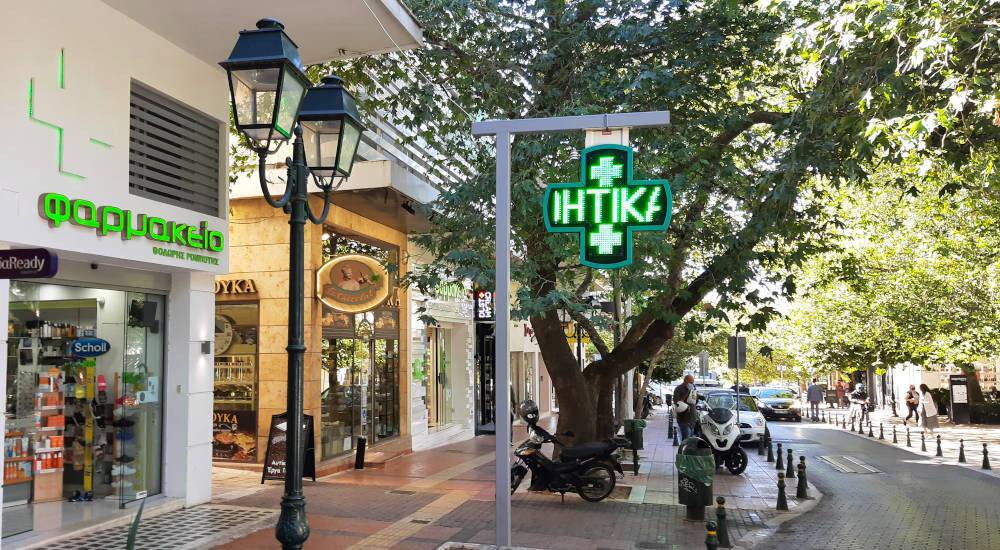
To find a pharmacy, look for the lighted green cross, easily spotted in their abundance throughout village and city centers. While opening hours are odd and vary (e.g. pharmacists on a small islands keep different hours from those in downtown Athens), they generally close for an afternoon siesta (on Wednesdays they might not open after the siesta) between 2pm to 5pm, and close all day on Sundays.
THE ON-DUTY PHARMACY: There is always one pharmacy in the area providing 24–hour services, and on Sundays or public holidays when everyone else is closed. Locate this by heading to the pharmacy closest to you – there should be a notice posted on the door showing which pharmacy is on duty. The notice is usually in Greek, so enlist local help or use Google Translate App’s visual translation ability. You can also try Vrisko’s search or call 1434.
– – – EMERGENCIES – – –
In practice (not quite in theory), emergency public healthcare is generally free in Greece, even for tourists. So even if you didn’t purchase travel insurance, you can visit with confidence. Go to the emergency department of a hospital or call the National Center for Emergency Care (EKAV) ambulance: 166.
For a private ambulance in Athens, Thessaloniki and central Greece, you can contact SOS Iatroi.
If you are on a small island with no hospital facilities and are in need of critical assistance, you will be transferred by an EKAV helicopter or ferry to a major city with a public hospital. Private air ambulance alternatives include Gamma Air Medical and Athens Medevac .
IMPORTANT CONTACTS
General Emergency Line for Greece and in Europe: 112 (in Greek, English, French) connects you to emergency services including the national ambulance service EKAV, Hellenic Police (ELAS), fire brigade, and the coast guard. It can work without a SIM card (normal carrier restrictions are ignored through this emergency roaming service), although you still need a signal to connect.
Other contacts:
- Hellenic Police (ELAS) – 100
- Tourist Police – 171 (in English, French and German) – part of the ELAS, trained to offer tourists help with local businesses 24/7
- Hellenic Fire Service – 199 – if you spot a forest wildfire, urban fire, or for rescue operations in accidents and natural disasters.
- Medical Emergency Service (EKAV) – 166 – the national ambulance service, also providing air ambulances to islands in collaboration with the Hellenic Air Force.
- Hellenic Coast Guard –108 – for emergencies and crimes at sea
- Roadside Assistance – call your car rental agency first. Alternatively, call ELPA at 104 for emergency breakdown services.
