
Every country has its peculiarities. If you’re travelling with children, kids are already full of surprises – you don’t need more from your vacation apartment rental. What are the less obvious things to look out for so you don’t get caught off-guard in Greece?
1. An “air conditioned holiday home” without air conditioning in bedrooms
When my husband said there was air conditioning in his parent’s home in Evia, I was a little surprised to discover that meant one air conditioning unit in the hallway to cool all three bedrooms in the apartment. So everyone sleeps with the doors open at night.
Greeks are not big on air conditioning, quick to cite its health-inducing hazards from stiff necks to sore backs. An air-conditioned apartment does not always mean air-conditioning in all rooms.
If you like your air-conditioning, and especially if you are travelling in July and August, check to ensure all the spaces you require them in have their own unit (reviews may highlight missing air-cons in rooms, or you might be able to spot its absence in pictures).
2. Cycladic villas with child-unfriendly features
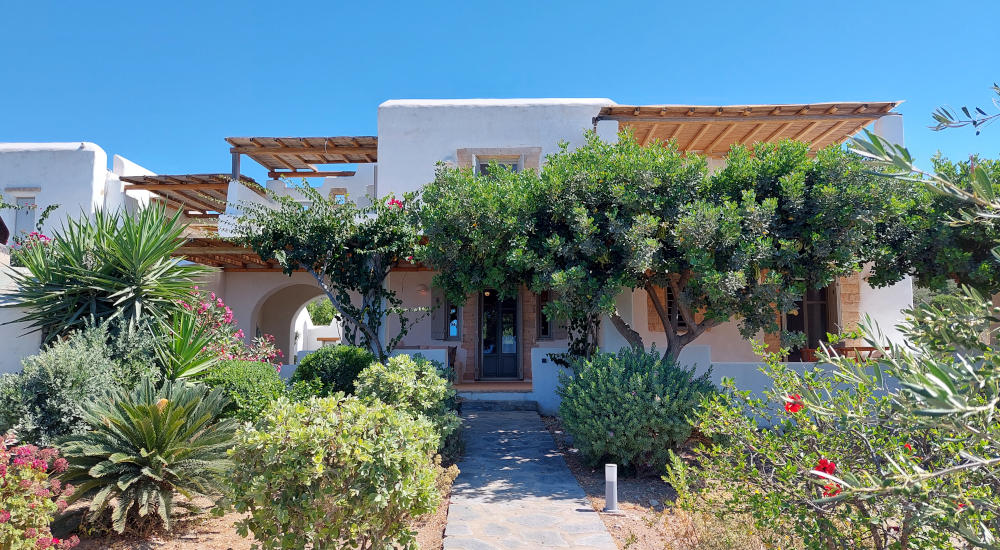
Cycladic houses (an architectural style unique to the Cycladic island group in Greece) have a special beauty for me, with cubic shapes, minimal lines and all-white façades.
Children, however, are clearly not a design priority in its architectural vernacular. Staircases often have no railings, while balconies feature low slung rails with child-sized gaps. There’s also concrete everywhere – built-in sofas made of concrete, concrete bedside tables, concrete wardrobes, concrete walls for shower cubicles, concrete floors…it’s all just a little harder on falls.


3. Floor plans with odd layouts, particularly with multi-level units
Many Airbnbs in Greece are designed primarily as a holiday home to rent. As a result, some have unusual layouts that are not quite ideal for long-term living. A recent beach house in Paros had the third bedroom connected to the rest of the house by an external staircase – quite beyond the point of booking a three-bedroom apartment for a family. If you need to be next door to sleeping infants and toddlers, check to make sure you have two bedrooms situated on the same level.
4. Bedrooms in basements (unless you like bedrooms in basements)
I’ve often booked a three-bedroom villa for a tidy sum. Leading to significant disappointment on discovering that some of these bedrooms might be located in cleverly disguised basements. Look at the window placement of bedrooms in featured photos to avoid a similar disappointment. If they are placed in a strangely high position (see picture below), this is likely to be a basement-level room.
Not the end of the world, but something I prefer avoiding. Particularly since, ambience aside, basements tend to get musky and dusty with windows opening out into the ground level.

Why does this happen in Greece? “Agricultural” land plots (allowing for commercial facilities like hotels) have a maximum allocation of built-up area, combined with a maximum of a two storey height limit. Developers often try to optimise within these limits by creating more living space in basements, inserting small windows at the top to make bedrooms less jail-like. Others do a more impressive job by digging extensively around the entire house to create a sunken area. They might even manage to put in full doors and full windows here, but these are essentially basement-level rooms.

5. Accommodation in the thick of busy Choras (town centers), and a car to park
Staying in the Chora might sound like a great idea for convenience, but the Choras of popular islands (e.g. Corfu, Chania in Crete) almost always present dire parking challenges. Circling the area in search for parking space for 20 minutes to an hour before finding a lot is not unheard of. And having to do that each time you return from a day’s outing with a baby in the car can easily ruin a fun day out.
