
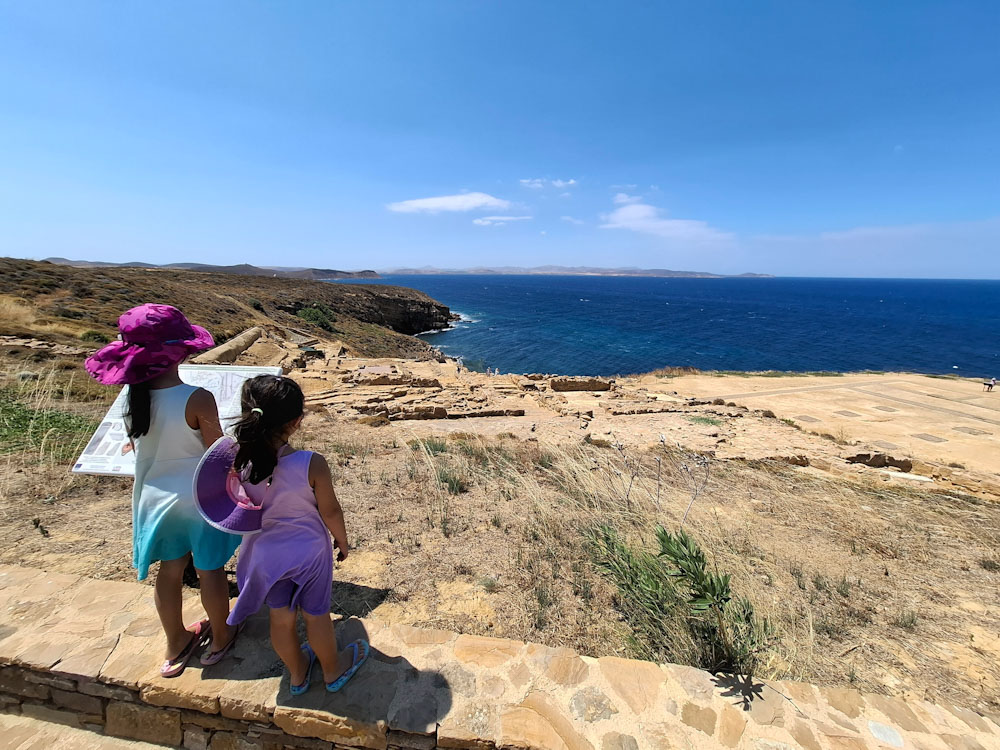
Greece has its quirks, from unpredictable opening hours to toilets that demand you bin rather than flush your toilet paper. Add these to the usual logistics of travelling with children and things can occasionally unravel. Here’s what you need to know to avoid the urge to smash plates, whether in a taverna or your Airbnb kitchen.
1. Water on most islands is not drinkable
Our first order of business on arrival is always a supermarket run, where we stock up on a small tower of 1-litre bottles of local spring water. We use bottled water for drinking and cooking, although tap water is generally safe for cooking on most islands.
There’s little reason to buy imported brands such as Evian or San Pellegrino, which typically cost considerably more than locally sourced Greek spring water. While Greece has price controls on bottled water where consumers have limited choice (capping at €0.60 for a 500 ml bottle)—such as passenger ferries and some transport hubs—supermarkets and convenience stores across the islands also stock excellent local brands at very reasonable prices.

2. Odd opening hours
Most shops, supermarkets and pharmacies included, are closed on Sundays. They might also close in the afternoon for a siesta (2pm to 5pm). And on Wednesdays, decide not to open after 2pm at all. Exceptions are made in popular tourist areas (e.g. downtown Athens and some islands in summer), thankfully. And while pharmacies might close on Sundays, there is always the “duty pharmacy” in the neighbourhood that will be open overnight, on Sundays, and public holidays. Every closed pharmacy will post its address on its door.
Archaeological sites are open on Sundays but close on Tuesdays. When they are open, they have early closing times at 3pm, so evening visits are not an option.
Seaside tavernas aside, restaurants may not open for lunch (especially in smaller islands like Serifos and Koufonisia), just for a late lunch or dinner from 4pm. Always check opening times ahead before you count on being served.
3. No flushing of toilet paper
Even the toilets of Greece are the stuff of ancient history. It is common to see signage telling you not to throw toilet paper down toilet bowls as this threatens to choke up dated sewage systems with small pipes. All the more reason for choosing an aparthotel over an Airbnb if you don’t want to deal with, on a daily basis, the messy business of disposing of everyone’s messy business. Trash aside (you will have to transport this to the communal trash bin if staying in an Airbnb), getting the kids in the car with beach gear in tow is already difficult enough.

4. The wind and the beach
While one Google reviewer might describe a beach as “crystal clear and calm”, another might find the same beach to be choppy and muddled with seaweed. As seasoned beach goers will know, the wind is an important factor in determining its conditions.
Check the direction and strength of the wind on a wind app before heading to your beach of choice. If it’s blowing from the north, the southern, sheltered beaches will be calmer. This is usually the case in the Cyclades with prevailing north meltimi winds that blow in summer.

5. Google maps and dirt roads
Take directions from Google Maps with skepticism in the countryside. It often mistakes small dirt paths and narrow village streets for roads, so it might be better to continue on a main asphalt road and wait for a re-direct if a turn looks suspect.

6. Use only licensed taxis and tour guides
Freenow or Uber are the popular apps for hailing taxis in major Greek cities (e.g. Athens and Thessaloniki). Radio taxis are the alternative option in smaller cities (e.g. Chalkida). On small islands (e.g. Ios and Koufonisia), ask your hotel or Airbnb host for local taxi service contacts available.
