
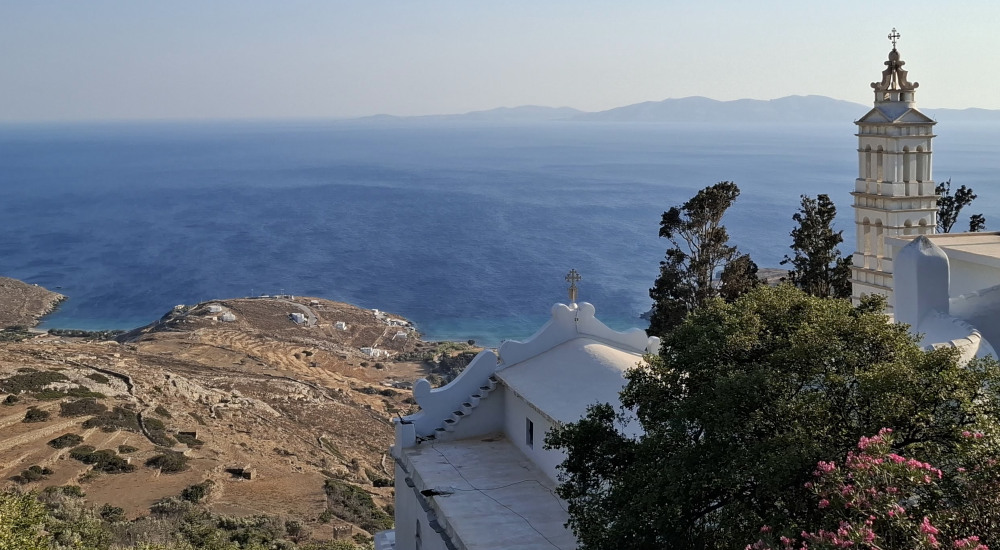
Tinos was the island yiayia (grandma) and her friends flocked to by the busload during off-season excursions, drawn to Greece’s foremost Orthodox pilgrimage site: the Panagia Evangelistria. Built over the ruins of an ancient Greek temple (as is the unfortunate custom of many Orthodox churches in Greece), it is said that Pelagia, a sainted nun, received a vision in 1822 which led to the discovery of an icon of the virgin Mary thought to be painted by the apostle Luke.
From religious devotees who crawl (some prepared with knee pads) the carpet that lines the stone paved road from ferry port to church, to the drystone walls painstakingly woven across its mountainscape from end to end, fortitude and devotion pervades the island spirit. Like the flowing lines raked through the gravel of a Japanese Zen garden, Tinos’ intricate network of dry-stone walls sweeps across its mountains from end-to-end, punctuated by monasteries and its distinctive dovecotes.

For me, Tinos’ draw is inland, where traditional villages are home to unique attractions. From Pyrgos and its marble craft heritage, and enchanting Kardiani, to Volax. Activities are more suited for older children (E.g. scaling the rocks of Exomvourgo, a marble crafting workshop, or to surf the waves at wind whipped Kolymbithres). And for little ones, Tinos has a selection of easy beaches for families (we spent most of our beach days at Agios Sostis). Not of the dreamy hues of blonde and blue shores like neighboring Mykonos and Paros, but where crystal clear waters gentle lap over gentle slate-sand shores speckled in silver. Just right for fortress sculpting.

WHERE TO STAY
There’s a clear sweet spot for families on this pear-shaped island. Perched along the lofty south-west coast, where evenings end with sublime sunsets, the area behind the beaches just west of the main town (starting from Ballos Beach) puts almost everything within easy reach. Most of the island’s highlights are just 20 to 30 minutes away by car.
VILLAGES
When you’re about to drag children on a village exploration, it helps to know what to expect. Somehow, they (mine, at least) fail to find the same curious enchantment in quiet wanders through residential village alleyways often ridden with stairs. Which is Kardiani. At least Volax has soft serve to lure little legs along. While larger Pyrgos is filled with so many pockets of attractions I would start my visit there early in the day.
— PYRGOS —
With marble found in abundance in northwest Tinos (Exo Meria), Pyrgos established itself as the greatest center of marble craftsmanship. Once a village of marble craftsmen and quarrymen that flourished in the 18th and 19th centuries, a Fine Arts School was established in 1955, and most recently, the Museum of Marble Crafts.
Sitting just outside the village, the museum is a thoroughly modern introduction to tools and technique of the craft—and a welcome refuge on a sweltering summer afternoon. Afterwards, drop into Michael Saltamanikas‘ workshop a few doors down from the marble bus stop, where you might catch him at work before choosing from his exquisitely carved creations.


Back in the village, boutiques occupy elegant stone buildings along stone-paved lanes that lead to a lively square shaded by a magnificent oak tree. There are numerous options for sustenance, but if pizza is the only thing your children eat, Dough Shaker has a mini-sized playground tucked below.
— KARDIANI —
As we filtered off the “main road” down the winding south slope of Mount Pateles, the unlikely sight of water-loving plane trees start to appear, gathering around a narrow ravine where a creek winds its way to the sea. A series of church spires float into view as you approach the village, fusing beauty with spirituality for an almost mystical sense of place.

Arrivals are welcomed by a small square with sweeping views across the bay below, centred on a fountain that has become a pond for orange fish, watched over by four marble frogs. With discreet villas and a handful of tavernas, shops and cafes, Kardiani remains wonderfully peaceful.
— VOLAX —
Amidst the jumble of giant, spherical boulders, Volax village sits. Village houses frame their walls around these marvellous rocks, lacing poetry on doors in random corners. When we arrive, a family picks up an unusually determined pace as they launch into an alley. And then another overtakes our languid wander. It turns out we are all converging at the soft serve bolthole. If you prefer a less heavily processed sweet treat for the kids, steer clear of the shop and plant yourselves at Kafe Nai for homemade cakes or a bowl of yoghurt with honey and walnuts.


Volax is a small village, where you’re likely to bump into the same people twice. Basket weaving was once the village’s defining craft, but only a handful of artisans remain. Pop into Loudovikos to catch a glimpse of how its done if you’re in time. Our old neighbours in Athens who made Tinos their new home enthusiastically suggest Aeraki Tiniako for food in the area. Not seeing their text message in time, we settled on the sun-dappled hillside terrace of Venerada. Within its soothing Scandi-rustic setting, thoughtful touches for families abound—from a child-sized table, colouring activities and games to a baby changing station. It’s meat-heavy menu is enticing, including rabbit stifado. A thoroughly beastly choice, according to my girls, whose look of disbelief as I placed the order permanently diminished my enjoyment of the dish.

— CHORA (MAIN TOWN) —-
You have to seek to find the beauty of Tinos’ Chora, which otherwise looks disappointingly like a whitewashed version of the 2 and 3-storey apartment blocks that dominated Greek city architecture in the 1970s. Not the kind of graphic Cycladic villages hidden in its hinterland. A small, more beautiful old town with neoclassical buildings flank the main road towards the church. One part (the portside) an unlikely huddle of bars that bustles with a sequin cladded party-set at night, and another part (the opposite end), a frenzy of souvenir shopping and sweets.


Where to eat with kids in town? Pranzo by the promenade on the waterfront has ample space for kids to dash around between bites, throw breadcrumbs to feed fish in the harbour, or browse the neighbouring bookshop for art supplies or a travel game. Every so often, a horse-drawn carriage clops past on its way to the nearby rank. The road closes to traffic after 9 pm, leaving the waterfront noticeably calmer for your evening meal.
GETTING THERE
Tinos is reached by ferry, most commonly from Athens’ ports of Rafina or Piraeus. Rafina is the more convenient option for many travellers, with frequent sailings during the summer and a shorter crossing of around two hours. Ferries also connect Tinos with neighbouring Cycladic islands including Mykonos just a 20 minute ferry ride opposite, with an international airport.
WHEN TO VISIT
Greek islands reward those who arrive outside the peak summer crush. June and September offer the perfect balance: the weather is reliably warm, the sea is inviting, and villages, beaches and tavernas retain their unhurried rhythm. July and August bring the island to life, especially around the Panagia Evangelistria pilgrimage on 15 August, when thousands of visitors descend on Chora for one of Greece’s largest religious celebrations.
